I’m taking a break from the book chapters (4 down, 17 to go!) in order to write a conference paper on Thompson and Dundy’s involvement with world’s fairs. Fred Thompson was a true exposition fiend. He went to the Chicago World’s Fair in 1893, which I talk about in this blog post (from almost 4 years ago?): Where to Begin? Frederick Thompson at the Columbian Exposition — Sunny Stalter-Pace. Then he got really involved in the preparation for the Tennessee Centennial and International Exposition in Nashville, where he lived and worked. His dad was a contractor, and his uncle ran an architectural firm where Fred worked as a draftsman and designer. Thompson had a reputation as an artist in Nashville already, where he drew the covers for a gossipy society magazine called The Mirror.
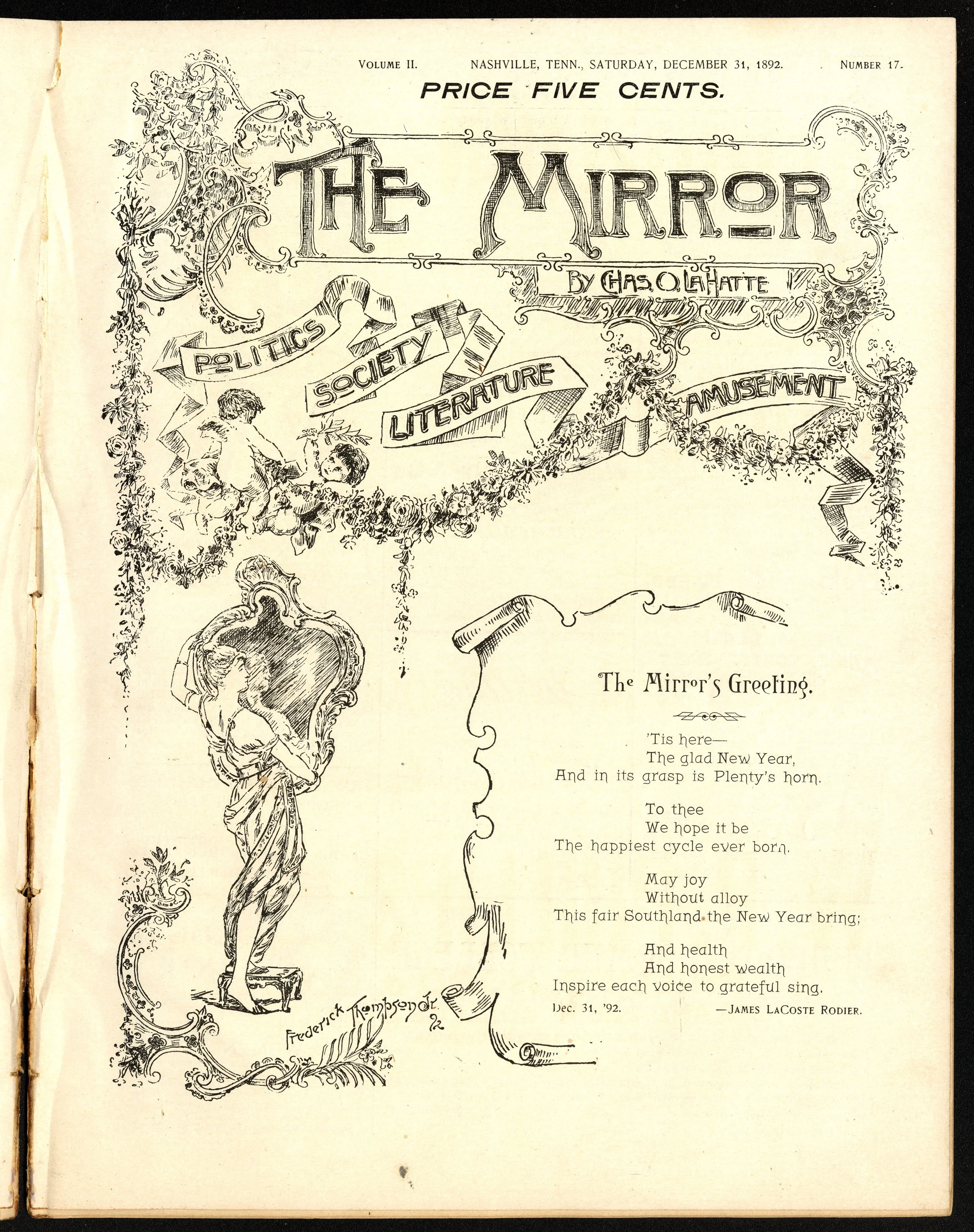
Cover to The Mirror II.17, December 31, 1892. Courtesy Tennessee State Library & Archives, Galvin-LaHatte family papers, 1864-1983. Finding aid at https://archives.tnsos.gov/ark:/55409/435952 .
Thompson had a lot of opinions about how the exposition should be run. After Charles Collier, president of the company that ran the Atlanta Exposition in 1895, addressed the board organizing the Nashville event, Thompson wrote an op-ed published in the Nashville American. Regardless of how Atlanta had run their fair, Fred Thompson did not think their Fine Arts exhibition should be run as Collier suggested. It’s a little in the weeds, but it sounds like Collier recommended against building a fireproof building (?) and said that the committee should buy the best artwork they put on display instead of offering prizes. Thompson thinks that offering prizes is a way better solution. It seems like a typical Southern rivalry where he thinks Atlanta was too practical and businesslike. Nashville was the Athens of the South (even before they built the Parthenon for this fair.) He ends the piece with the dismissal of a true aesthete: “Pray let us cater to the art of artists rather than the formless color of ‘nobodys’”
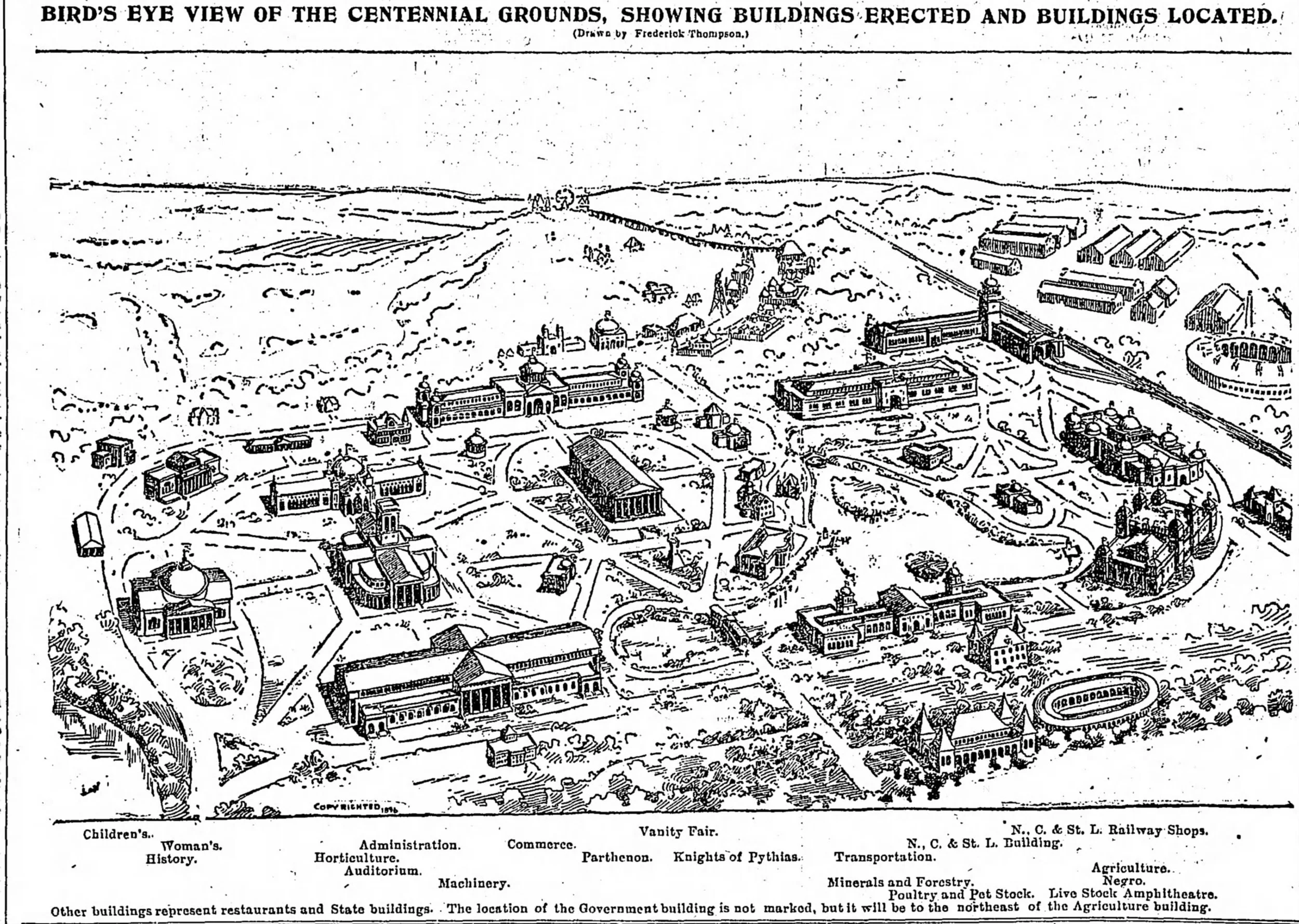
Thompson, Frederick. “Bird’s Eye View of the Centennial Grounds, Showing Building Erected and Buildings Located.” The Tennesseean, 31 May 1896, p. 11.
Thompson tracked the progress of the fair, drawing this map for Leslie’s Weekly while some buildings were still under construction. One of the buildings was his own design. The Negro Building design earned Thompson an Architectural Design Medal that came with a $2,500 prize. I do wonder if Thompson’s uncle co-owning “one of Nashville’s leading architectural offices” may have had some influence on Thompson winning the prize for this building’s design.
The building was designed in a Spanish Renaissance style including the kind of ornamentation that Thompson always loved. That style incorporates Moorish aesthetics, showing the influence of North African art on the Iberian Peninsula. This makes it a good choice for the building that exhibited the work of African American artists and HBCUs like Fisk and Tuskegee. Here’s what that work looked like:
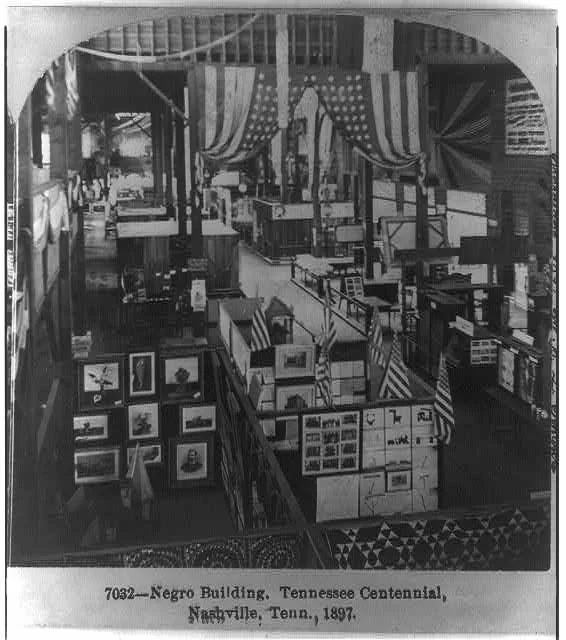
Interior exhibit space, Negro building, Tennessee Centennial, Nashville, Tenn., 1897 via Library of Congress, http://hdl.loc.gov/loc.pnp/cph.3a30405
Here’s a picture of the building from the outside:
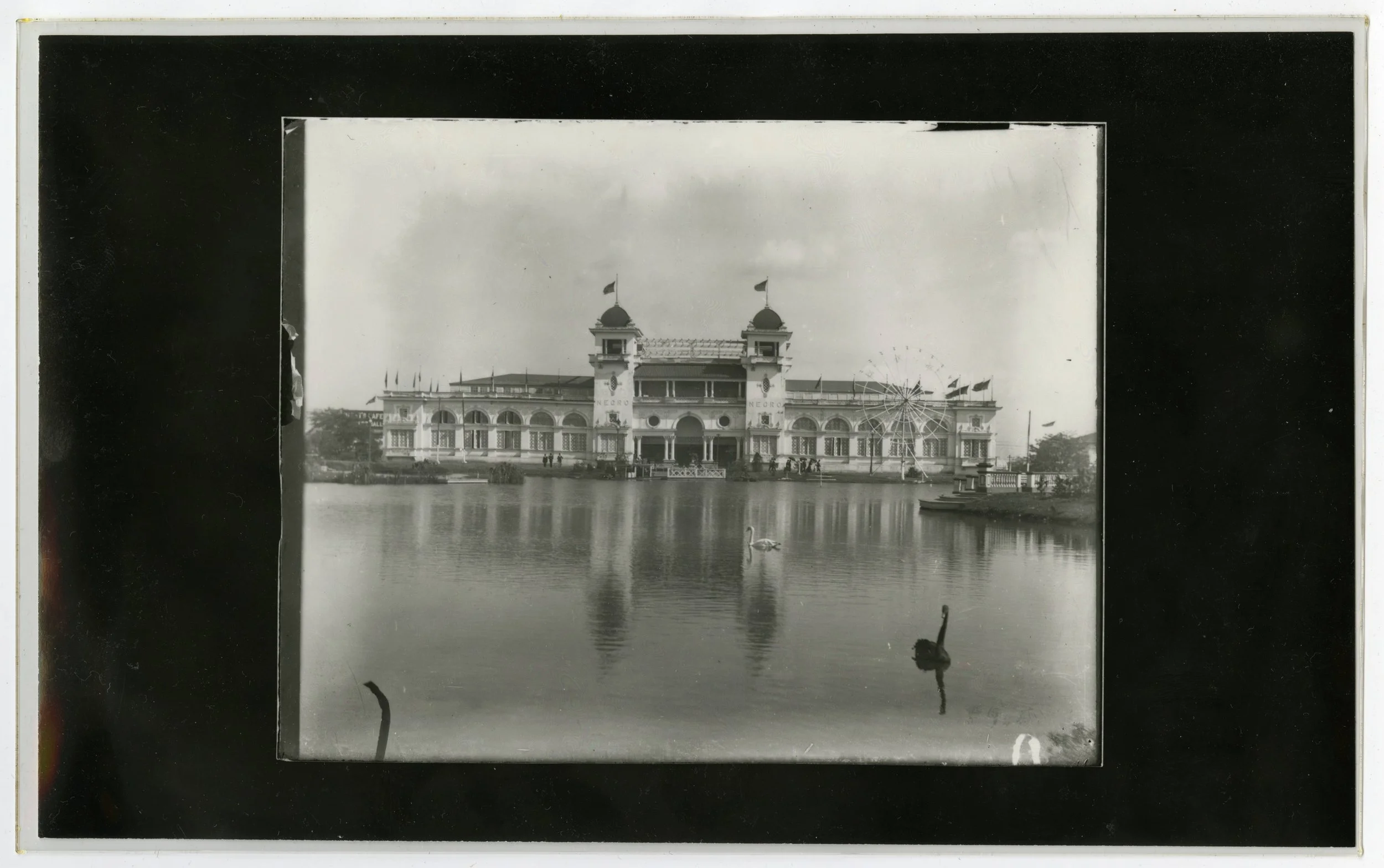
Negro Building. Courtesy Tennessee State Library & Archives. Wiles Photographic Collection, 1896-1910 Accession number THS 682. Owning Institution: Tennessee Historical Society. ID# 33207.
Thompson loved to design and build things near bodies of water. His letter home at the World’s Columbian Exposition raved about the lagoon with a boat launch, and Luna Park had a big central lagoon too. I think that carried over to his Hippodrome design with the water tank below the stage apron. He just loved the theatricality of water. Once the Tennessee Exposition started, Thompson took over a nearby concession on the same manmade lake called the Blue Grotto.
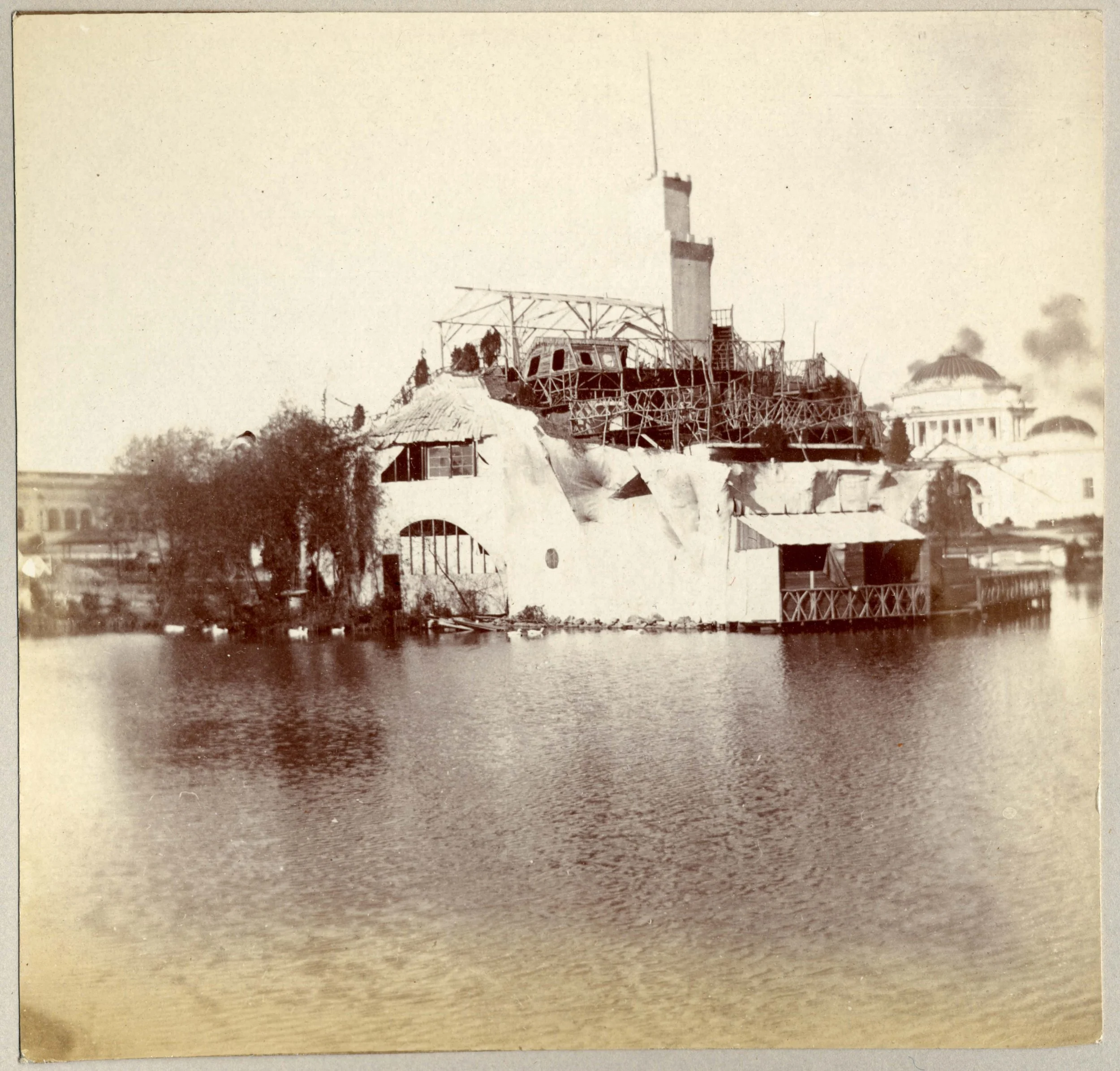
Blue Grotto. Courtesy Tennessee State Library and Archives. Webb-Wrenne Family Papers, 1856-2005. ID number 33246. Owning Institution: Tennessee State Library & Archives. https://digitaltennessee.tnsos.gov/context/tennessee_centennial/article/1037/viewcontent
Here’s how that exhibit is supposed to work, according to the Official Guide to the Tennessee Centennial and International Exposition:
the guard directs you to the mouth of a dark cave, and, for a few moments, you are transported to that land made famous in song and story and lose yourself in “Capri’s blue grotto.” Winding around through a rock passageway, you suddenly come out on the edge of a lake. Before you is the Bay of Naples in all the beauty of sunset, and around you is the heavenly blue of water and grotto. As you look the sun slowly sets and Naples, even more beautiful in moonlight, appears. In the distance is heard the sweet voice of an Italian singing, with a mandolin accompaniment, and a boat floats into view w'ith the singer in the stern. The guide then tells you, if you still wish to imagine yourself in Capri, you can go upstairs and take lunch in the castle. So up the winding stairs you go, into the spacious dining hall of the old castle. While you enjoy your lunch of spaghetti and crisp Italian bread and sip your gold chianti, you can look out over the beautiful white city.
So the first part of the concession is the cave, which Thompson took over. According to Norman Clarke in The Mighty Hippodrome, Thompson salvaged a “static” exhibit with some new technology. He recorded a lecture about the Blue Grotto in Capri (which this papier-mache cave was supposed to represent) and played it on an Edison talking cylinder. This combination of escapist scenery and modern technology was Thompson’s forte. But that’s not the only thing Thompson added to the concession.
Two want ads in the Nashville Banner show how Thompson pepped up his exhibit. The first, from July 8, 1897 asks for a “Girl, small brunette, with good figure and regular features to pose in tights and drapery at Blue Grotto.” The second, from September 9, 1897, asks for three string musicians to play dance music. I think these two additions are really interesting, in part because of the way people talk about how American world’s fairs separate out the aesthetic and intellectual pleasures of the fair from the embodied, sensual pleasures of the midway or its equivalent. This is definitely a place where Thompson brought them both together.